Many parents experience that their children are part of pride celebrations at school – often without clear information, without real alternatives and with limited opportunity to opt out. When they contact the school, they often receive responses that refer to values and intentions: that pride is positive, that it is about inclusion, and that it is in line with the school's values.
But this raises a more fundamental question: What does the legislation actually say – and how should the rights of students and parents be safeguarded?
When the answers lack legal basis
A common experience is that schools do not provide clear answers on how students' rights are safeguarded in the face of such markings. Instead, they refer to general statements and value-based justifications, rather than specific assessments of rights.
When parents ask questions, the school must be able to show how the situation has been assessed and how the students' rights are being safeguarded. The lack of clear answers makes the situation confusing and demanding for many.
In the face of pride celebrations in schools, several basic rights apply:
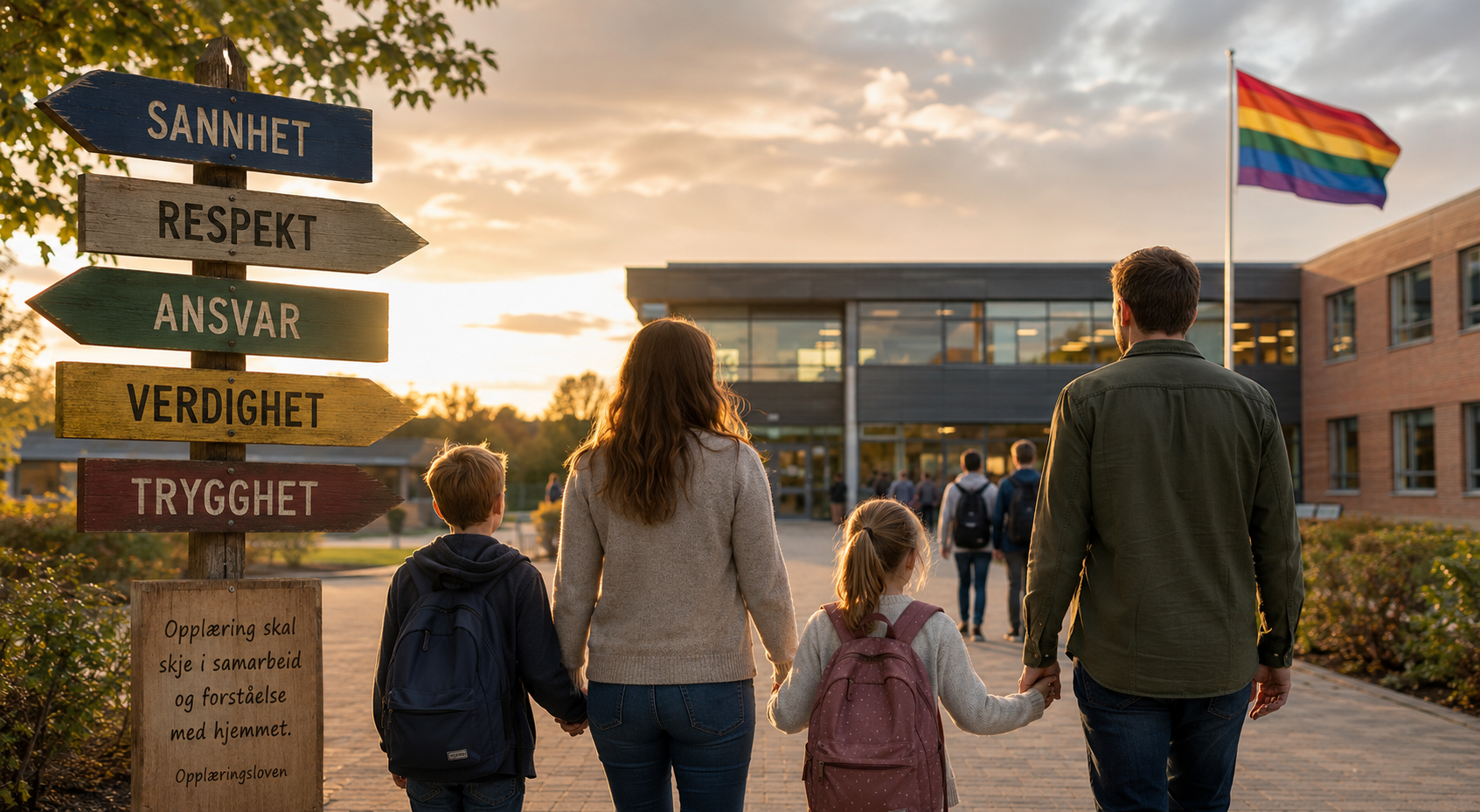
• The training should take place in collaboration with the home and with respect for the parents' beliefs. • Students have the right to a safe and good school environment – without pressure, exclusion or abuse. • There is a right to exemption from activities that are perceived to be contrary to one's own beliefs or views on life. • The school must act objectively and pluralistically in issues that are controversial in terms of values.
In practice, this means that the school cannot carry out activities in a way that is perceived as one-sided or pressuring, without at the same time ensuring real and equal alternatives – – and without being able to show how the students' rights are safeguarded.
Collaboration with a lawyer
To meet this challenge, we have developed a legal memorandum in collaboration with lawyers, based on experience from specific cases. Together with associated resources, it should be easier to engage in dialogue with the school in a clear and objective manner.
The note and letter templates help you, among other things, to:
• Get clear information about the program • Ask the school to explain what it is based on • Request an exemption or an alternative • Ask for a clear and reasoned response in writing.
The goal is not to create conflict, but to ensure that rights are actually protected – and that school remains a safe place for all students. Therefore, this is not primarily about for or against pride, but about an important boundary: that children should not experience pressure to participate in celebrations or endorse certain views.
When such situations arise, it is legitimate to ask for clear answers.
See the review of the resources
In the video below you can see a review of the legal memorandum from a lawyer – and how it can be used in meetings with the school. Resources and letter templates are available at www.stoppride.no and at the bottom of the article.
In the midst of a dating culture characterized by quick choices, uncertain relationships, and ever-changing opportunities, more young Christians are beginning to ask a simple question: What if love is about more than…
Truls Olufsen-Mehus has reported Hammerfest Municipality to the police for violating the Act on Flags on Municipal Public Buildings §1. In this review, he explains what is behind the report, what documentation it…
The splicing is over. On behalf of everyone at Kristent Ressurssenter, we, Tone Lise and Truls, who are the general manager and chairman of the board, would like to thank everyone who supported our fundraising campaign in June…
In a culture where instant gratification is often held up as the ideal, waiting until marriage to have sex is often portrayed as old-fashioned or extreme. Yet both experience and…
In Norway, we have made early kindergarten the norm. The one-year-old is delivered, the parents go back to work, and society nods approvingly: This is how we do it here. It is effective. It is…
To gain access to legal assistance, these are the criteria: Many parents and students experience that pride celebrations, flag-raising, educational programs or activities in school are carried out without sufficient consideration for parental rights, freedom of conscience,…
What happens when pride in schools and kindergartens is no longer just a celebration, but becomes something children, parents and staff are expected to adhere to? We have now started…
In the face of an increasingly clear struggle for values in society, Christian schools, parents and local communities are faced with a choice: Should we passively adapt to the pressure – or actively take responsibility for…