Morten Rosenkvist has drawn the wrong conclusion on the wrong premise and completely departs from the values of education, writes Truls Olufsen-Mehus in his debate post. Read it here:
Director of the Norwegian Directorate of Education (Udir), Morten Rosenkvist, writes in a The Norwegian newspaper that celebrating pride to teach children and young people about our fundamental values is entirely in line with the school's purpose.
(Aftenposten would not accept my counter-article.)
But this is the wrong conclusion on the wrong premise and it deviates completely from the value basis of education. This is because schools should base their practice on the purpose clause in the Education Act’s value foundation. It states that “education is based on the values that unite Norway as a society, the common values that are based on the Christian and humanistic heritage and tradition.”
Director Rosenkvist must understand that the Christian heritage and tradition on which our Constitution is also based are what unite Norway. By contrast, the Pride flag, which communicates pride, stands in conflict with Christian values, and ethically following one’s desires is likewise a contradiction. To conclude, therefore, that Pride represents Christian values on which education is based is contradictory.
It is a Christian view of values that formed the foundation of Norway as a society, and that is why we have a cross in our beautiful flag in red, white and blue. Otherwise, it is not a pride flag with six colors that represents the schools' value base or the prevailing values of pride that unites Norway.
Furthermore, Director Rosenkvist writes that “marking Pride can have a great impact on children’s and young people’s experience of belonging and being accepted, and that everyone should experience being part of a community in school and kindergarten.” The premise is again wrong, because it is not the case that the Pride flag is the basis for acceptance and inclusion in school.
Why is the use of flags of great importance?
On one of England's strictest school works the world's strictest teacher, Katherine Birbalsingh. She says that they have had great success working with the well-being and inclusion of all children. They teach that despite everything not being perfect, the children learn that they have the power within themselves to make active choices in their own lives because they live in England. All children learn to love the country they live in. – because that is what unites everyone. Regardless of ethnicity, gender, sexual orientation and religion – all the children there learn to love England and they unite under the English flag.
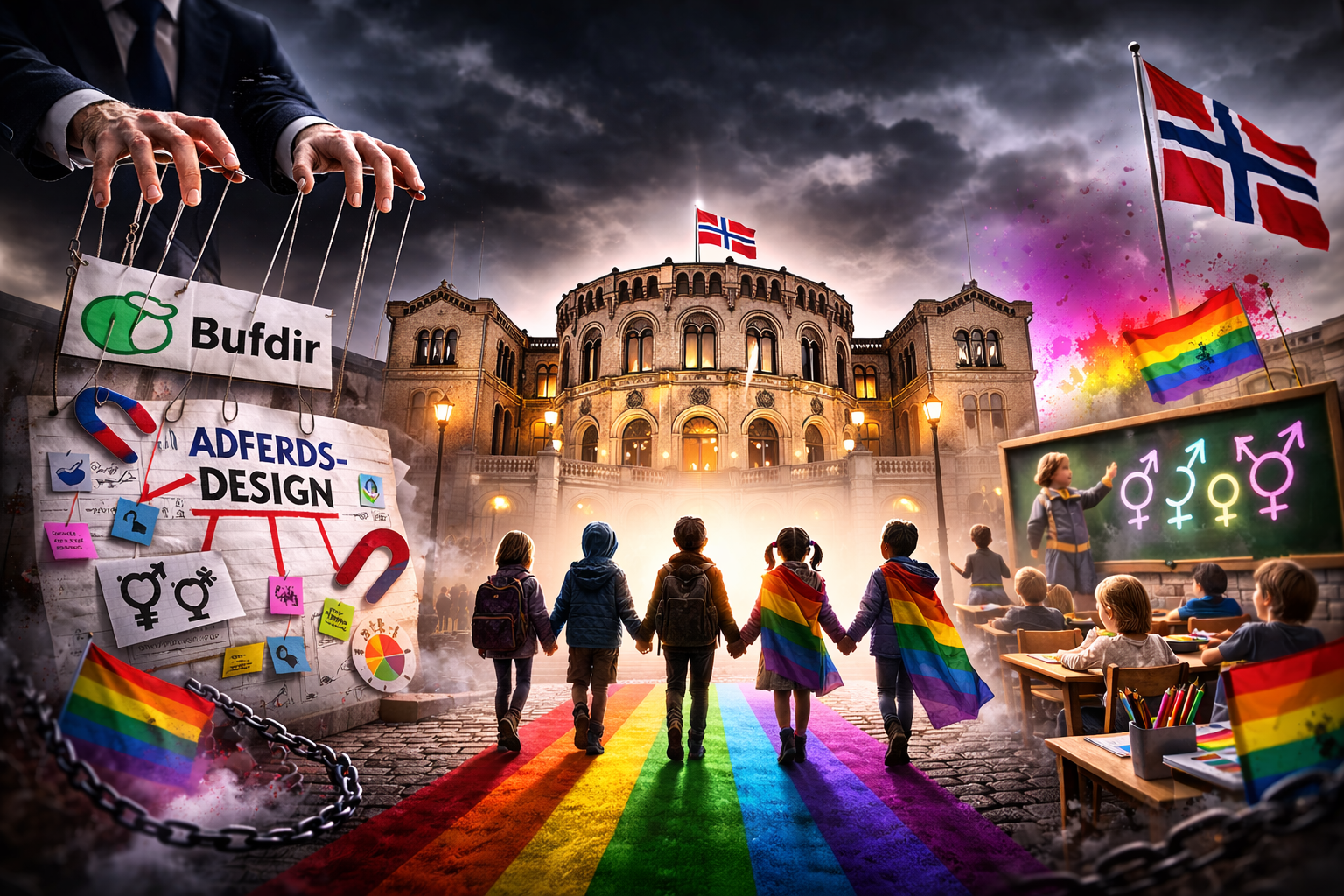
In Norway, Udir Director Rosenkvist also wants children in schools and kindergartens to be united under one flag. However, not the Norwegian one, but a Pride flag. The Pride flag, which represents a political symbol and therefore is not used on flagpoles at the Storting, is instead proposed for schools and kindergartens. I think many people believe this is wrong. So do I.
Furthermore, Rosenkvist argues that the use of nicknames related to sexual orientation and gender identity represents attitudes that do not belong in school, which is why Pride is needed. Here another logical short-circuit occurs. Because absolutely no one should be bullied or called anything derogatory based on who they are. And this brings us back to the fact that the Norwegian flag unites all children under its banner, under common values, and into one nation.
Forced Pride in schools and kindergartens will hardly prevent bullying or reduce exclusion, but will more likely lead to more conflicts and greater exclusion. This is because the Pride flag is political, and politics divides. Pride divides both parents and students. We see this increasingly in the media, and several surveys in VG, TV 2, Norstat, and Nettavisen show that the majority of Norwegians believe that pride has gonetoofar. These signals must be taken seriously.
Then comes the decisive point. Director Rosenkvist asserts that, as the subject directorate, it is not true that celebrating Pride in school goes against the curriculum. But Pride does exactly that if we compare Pride with Christian values and the Pride flag with the Norwegian flag. What serves the best interests of children? I have no doubt.
In the general part of the Education Act we read that: Christian values shall characterize the school's and teachers' encounters with the students and with the homes. The best interests of the student shall always be a fundamental consideration. There will always be tensions between different interests and views. Teachers must therefore use their professional judgment so that the individual is best cared for in their encounters with the community.
The entire section suggests that students should be cared for with love, care, for their faith, for their gender, and all other parts of themselves. There is nothing here that says that pride flags are the solution.
It is the Christian values, the Norwegian flag and the overall part of the Education Act that are the foundation that will ensure that students in Norway will be cared for and experience unity.
Rosenkvist's post contributes to worsening the situation for students, parents and teachers alike. He points to Pride as the best answer for children, but educational values hold the answer —values to which the director himself is bound. His answer and that responsibility are not the same.