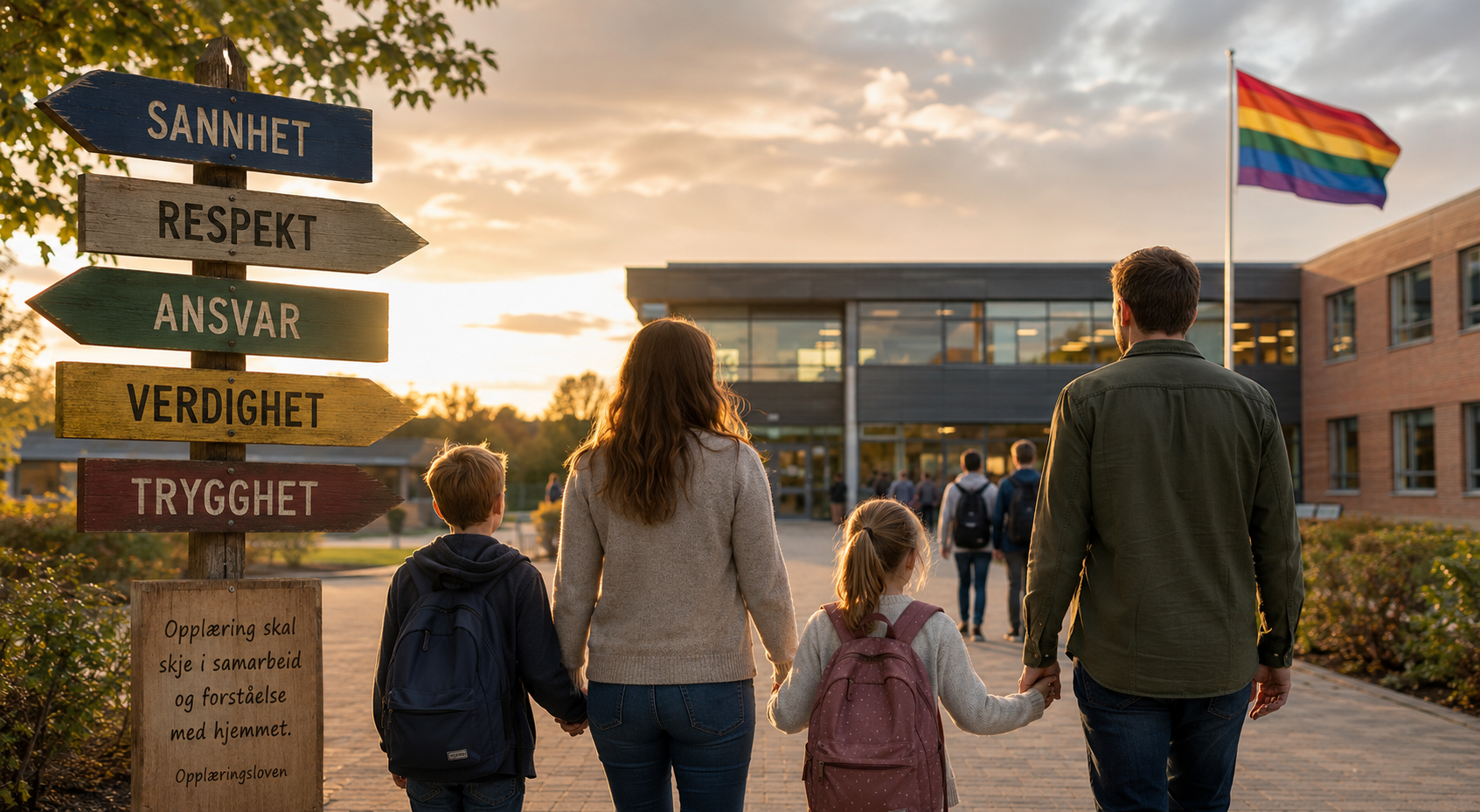
Kristent Ressurssenter has created a draft letter or email that can be sent to principals, municipal leaders, school management and the school owner with legal provisions that are violated by forced pride marking, or pride flagging on public flagpoles in schools. We have emphasized the Education Act for the students, and parental rights for parents.
To the principal of [school name]
Concern and protest against pride celebrations at school – with demands for legal response and cessation of pride
Introduction to protest: We, as parents of students at [school name], hereby wish to express our strong concern and protest against the school's participation in the celebration of pride. This applies to both the hoisting of the pride flag and the use of associated symbols during school hours and on school grounds. We demand that our rights as parents be safeguarded, that pride celebrations and related measures cease, and in this letter we would like to elaborate on the rights that both we as parents and our children as students at the school have.
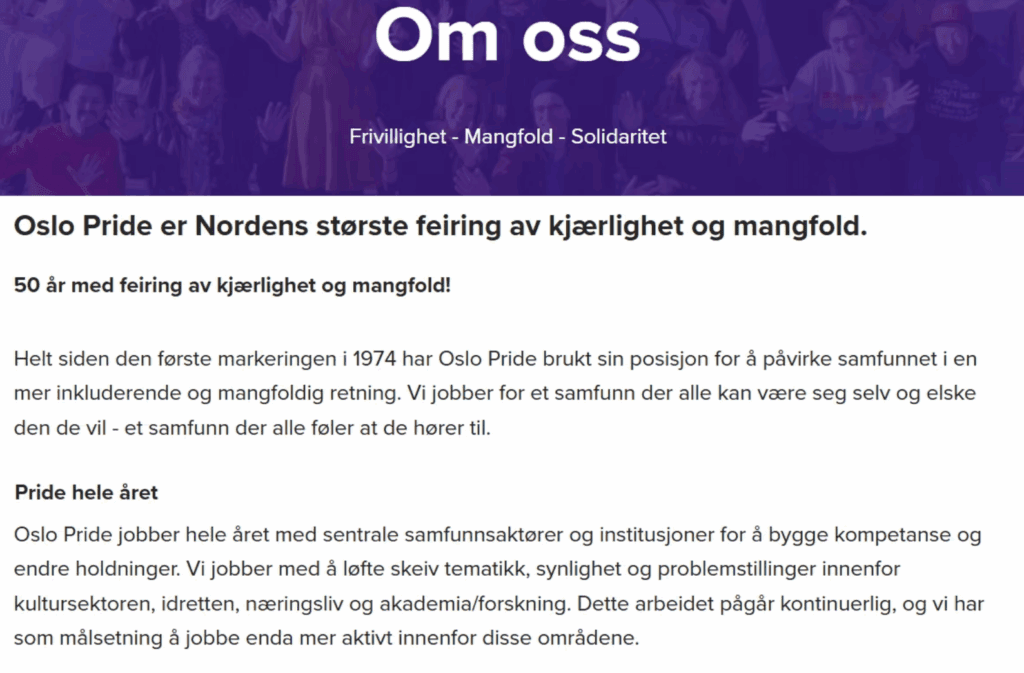
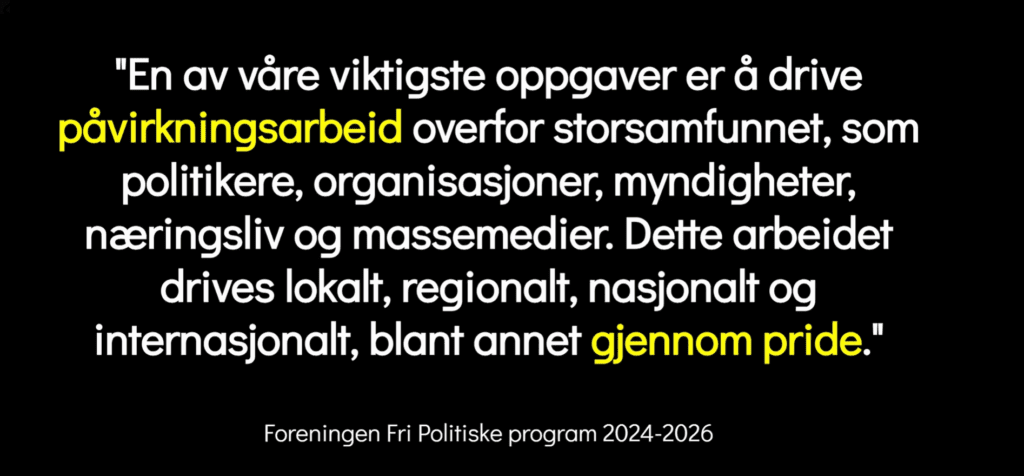
Objective description of pride: Pride is political, owned by a political interest group with stated goals of radical changes in attitudes and laws. The images below are excerpts from Foreningen Fri (main organizer of Pride in Norway) and Oslo Pride, which document that the goal of pride is “to change people's attitudes” and “influence society at large”". Pride is therefore, by definition, a political marking – which also means that statutory provisions must be applied. For the same reason, the Storting does not raise the pride flag, as pride is considered a political symbol. Why then should pride be celebrated at our school? More documentation about what pride is and what the movement's goals are can be found here.
In our opinion, pride at school violates several provisions of the Education Act, provisions that are intended to ensure an inclusive learning environment for all students – regardless of political stance, faith or outlook on life. We experience that our children's rights are not being safeguarded, and therefore request a legally justified answer on how the principal will ensure that these rights are respected. See part 3 for our demands.
ATTENTION! We would like to point out that neither the principal's personal opinion on pride, any municipal council decisions on pride, nor Udir's Director Morten Rosenkvist's reader contribution that pride belongs in schools can set aside the legal provisions that give us rights. It is our rights that you are obligated to protect when the school itself initiates the celebration of pride.
Part 1: The student's right to a safe, inclusive and neutral school environment
The right to a safe and good school environment
Education Act § 12-2, §12-3 and § 12-4 According to the Education Act Section 12-2, all students have the right to a school environment that promotes health, safety,inclusionandwell-being. For many children – especially those from Christian, conservative or traditional backgrounds – pride flagging and associated celebrations are experienced as ideological pressure, and as an invasion of their own identity and beliefs. This can create dissatisfaction, exclusion and a feeling of not being respected, but rather being run over.
The school must work against any form of bullying,discriminationand violation pursuant to the Education Act §12-3. Pride celebrations have strong political and ideological undertones and slogans – and are experienced as uncomfortable for students who do not share this view. The school shall not promote one value standpoint over others in matters concerning identity and outlook on life, with the exception of the Christian and humanistic value basis, cf. the general part and the Education Act §1-3. We, together with many Christian parents, therefore believe that pride celebrations in schools violate Christian values, and that compulsory participation entails a violation of several legal provisions.
The school has a duty to intervene when a student is not feeling “safe and well”, cf. the Education Act § 12-4 – even when this is due to value influences and activities that are perceived as offensive, offensive, exclusionary or discriminatory. For our children, pride celebrations create an outsider and discomfort. This alone is enough to activate demands for action. A minimum measure would be to offer an alternative program for our children, but the most appropriate and inclusive measure is to refrain from celebrating pride at school.
Prohibition of opinion-influencing advertising
(Education Act Section 27-1) Section 27-1prohibits messages that may create commercial pressure or influence attitudes and values at school, during school hours and in the classroom.
Pride is closely linked to political activism, organizations and campaigns with clear attitude-forming messages, see figures 1 and 2 above, pride itself is described as “influence work” and a work for “attitude change”. This is the organizers’ own stated mission, also from Oslo Pride. When such political influence work is taken into the school area, the limit of what the school has a mandate to promote is exceeded. It is not the school’s task to shape the students’ attitudes on such issues through the use of symbols or campaign-oriented activities.
Part 2: Parental rights – the child's upbringing is the responsibility of the parents
At the same time, we remind you that children are not the property of the state, but primarily the responsibility and care of parents. It is our right to transmit our own values and beliefs to our children. This right is clearly anchored in both Norwegian and international legislation, and we expect the school to comply with the laws that give us as parents rights in the school.
Parents have the right and duty to make decisions in the child's personal affairs, and must ensure proper upbringing and education adapted to the child's needs and beliefs. When the school overrides or undermines family values, and at the same time rejects parents who protest against pride, this constitutes a violation of parental rights.
Education Act Section 1-3 – Cooperation and respect for parents' values
The training should take place in cooperation and understanding with the home, and it should showrespect for the individual's convictions. This means that children should not be forced to adopt political or ideological symbols that conflict with the family's outlook on life, as pride symbolism does.
Constitution Section 109 – The child's right to adapted education and respect for human rights
Education should take into account the needs of each child and promote respect forthe rule of law and human rights. This requires safeguarding the rights of parents – including conservative and Christian parents, as specified in Article 2 of the ECHR.
ECHR Article 2 – Parents' right to faith-based education
“Functions the state assumes in education and teaching (school owner, principal and teachers) shall be exercised with respect for the right of parents to ensure such education and teaching in accordance with their own religious and philosophical convictions”
The state therefore does not have the right to override parents' faith-based or philosophical beliefs in schools. When schools introduce ideological or political influence with pride marking and associated symbolic use, without the parents' consent, it constitutes a violation of fundamental human rights.
Part 3: Our requirements
We require a response from the principal in accordance with Section 11 of the Public Administration Act, a response that legally explains our rights, and that confirms that the principal has understood the rights we have listed in this letter.
We demand that the principal refer to each individual legal section we have cited and explain how the school will ensure that both our rights and those of our children are protected, when we believe that pride marking, pride flags and pride effects violate these.
We urge that:
The school does not mark pride with flags or symbols during school hours, cf. the reasons given above.
Real dialogue is established with parents before any future markings are considered.
The school respects the student's right to a school environment free from ideological and political influence, and parents' right to decide on issues related to life philosophy, by meeting our demands.
Alternatively – if the school still insists on flying a flag as a mark – when flying a flag on the school premises, only the flag that includes all students should be used: the Norwegian flag (possibly supplemented with the Sami or Kven flag).
We would like written feedback on how the school is addressing these legal obligations.
With kind regards, [Name of parent(s)] [Contact information] [Student's name and class]
In the midst of a dating culture characterized by quick choices, uncertain relationships, and ever-changing opportunities, more young Christians are beginning to ask a simple question: What if love is about more than…
Truls Olufsen-Mehus has reported Hammerfest Municipality to the police for violating the Act on Flags on Municipal Public Buildings §1. In this review, he explains what is behind the report, what documentation it…
The splicing is over. On behalf of everyone at Kristent Ressurssenter, we, Tone Lise and Truls, who are the general manager and chairman of the board, would like to thank everyone who supported our fundraising campaign in June…
In a culture where instant gratification is often held up as the ideal, waiting until marriage to have sex is often portrayed as old-fashioned or extreme. Yet both experience and…
In Norway, we have made early kindergarten the norm. The one-year-old is delivered, the parents go back to work, and society nods approvingly: This is how we do it here. It is effective. It is…
To gain access to legal assistance, these are the criteria: Many parents and students experience that pride celebrations, flag-raising, educational programs or activities in school are carried out without sufficient consideration for parental rights, freedom of conscience,…
What happens when pride in schools and kindergartens is no longer just a celebration, but becomes something children, parents and staff are expected to adhere to? We have now started…
In the face of an increasingly clear struggle for values in society, Christian schools, parents and local communities are faced with a choice: Should we passively adapt to the pressure – or actively take responsibility for…