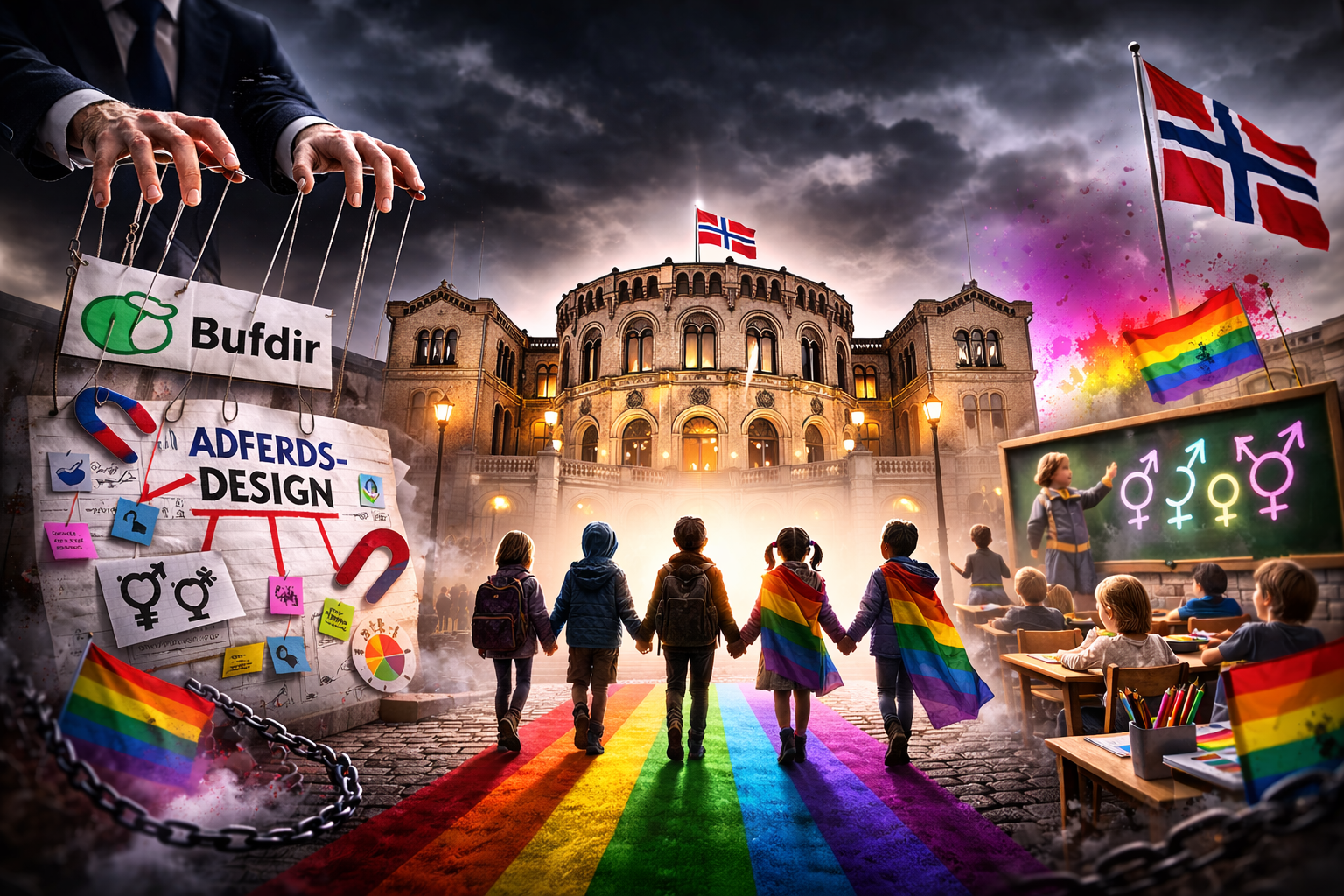
The state commissions behavioral design to influence views on gender
Published: 26/02/2026
It has recently emerged that Bufdir (the Norwegian Directorate for Children, Youth and Family Affairs) will spend several million kroner on a project in which behavioral design is one of the methods. The goal is to influence public employees' understanding of gender and gender diversity.
The contract mentions the use of psychological mechanisms to trigger desired behavior. Behavioral design is described as a methodological approach in the project. This is not just about information, but about influencing choices and practices – which raises questions about where the line is drawn between competence enhancement and controlled attitude change.
NOU about birth rates
A short time ago, a NOU about low birth rates was presented – Politics for new generations. Chapter 51 states that in liberal democracies such as Norway, it is considered illegitimate for the state to attempt to influence citizens through opinion campaigns on major life issues, such as the desire to have more children.
The committee therefore points out that it is not considered legitimate to use attitudinal influence to change the population's views on such issues. At the same time, behavioral design and psychological tools are used in a project related to gender and gender identity.
Treatment of children and adolescents – a controversial field
When the topic affects children and young people, the question of method and legitimacy becomes particularly serious.
The UKOM report which came out two years ago, describes puberty blockers, hormonal treatment and surgery for children and adolescents as treatments with a weak evidence base and the nature of experimental practice. The report emphasizes the need for greater caution and a better evidence base.
At the same time, in recent years there have been a number of media stories about people who have undergone gender-affirming treatment and later express regret. Several talk about psychological challenges, trauma or underlying conditions that were not adequately investigated before medical treatment was initiated.
When irreversible interventions are a reality, and the knowledge base is described as weak, the question of state influence becomes extra important.
Part of a broader strategy
The project must also be seen in light of The government's action plan for gender and sexual diversity 2023–2026. It states that consideration for gender and sexual diversity must be taken into account in the work to ensure equal public services. The measures include, among other things, capacity-building in the public sector, schools and digital platforms.
This is part of a broader government initiative on gender and sexual diversity.
When the state itself states that influencing attitudes in major life issues is illegitimate, but at the same time uses behavioral design to influence the understanding of gender, a question of consequence and legitimacy is raised.
See the full review below 👇 The documents, the NOU and the background of the project are explained in more detail in the video.
It has recently emerged that Bufdir (the Norwegian Directorate for Children, Youth and Family Affairs) will spend several million kroner on a project in which behavioral design is one of the methods. The goal is to influence public…
Over 1 million people have watched the video where we addressed sexualized activities in kindergartens. Now we follow up with a thorough review of why this is happening – and what food for thought…
There are just over 200 so-called NACS-approved sexologists in Norway who are referred to as experts on gender and sex in the prevailing doctrine that is based on sex-positive philosophy, queer theory and sexually liberal sexology. …
In this podcast episode, Truls Olufsen-Mehus and Tone Lise Gustavsen delve into the complexities of sex education, with a particular focus on new approaches that need to be adopted in the public…
Pornography is often described as a private choice with no consequences for others. In public debate, it is often presented as neutral entertainment, or as an individual need that does not concern the relationship one is in…
Many people today grow up with the understanding that sexual orientation is something fixed and unchangeable – closely linked to one's own self-perception and feelings. This way of thinking characterizes…