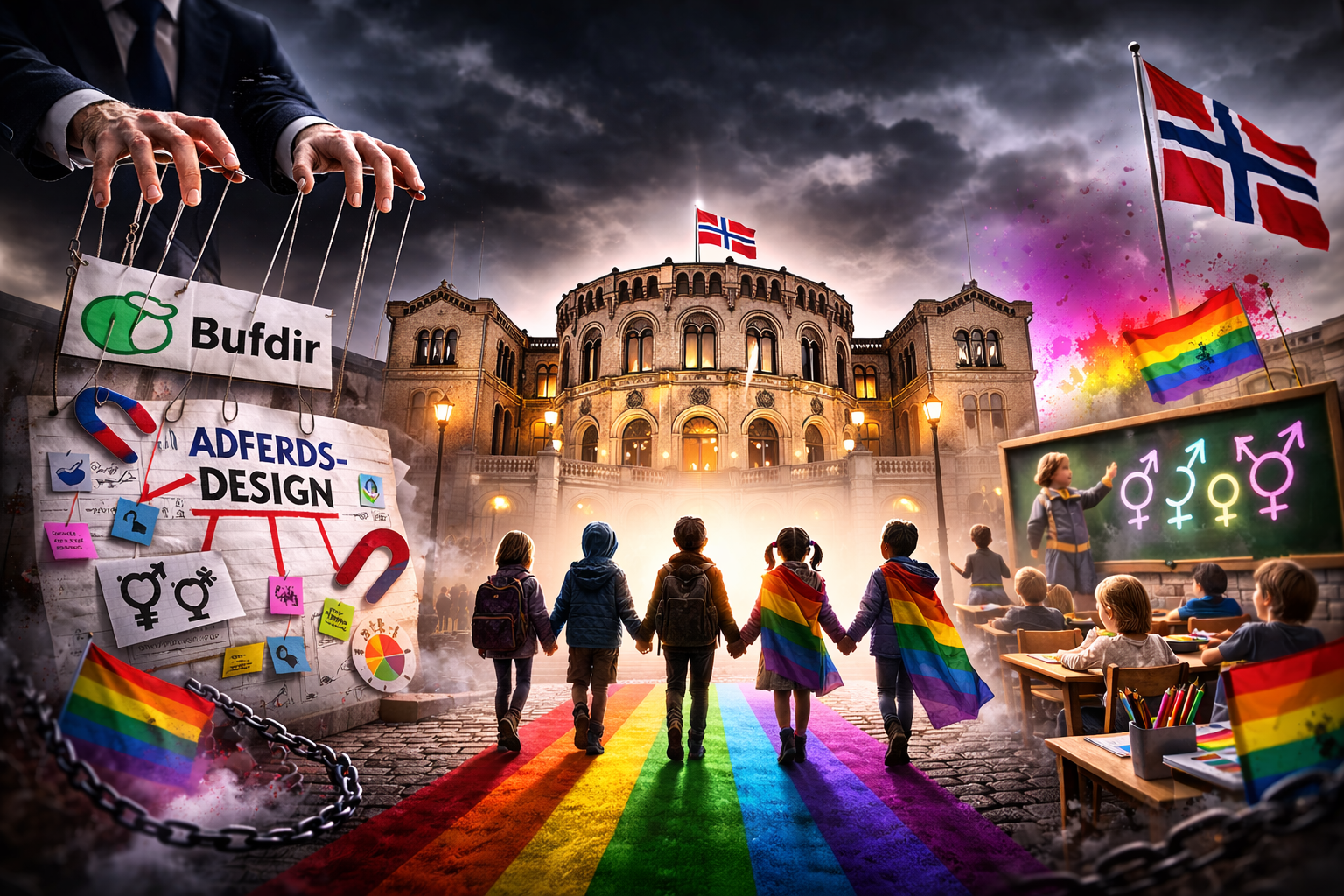
The school is supposed to be politically neutral, but every year children and students are forced into ideological celebrations they did not ask for. Why do we accept this – when even the Storting says no to the pride flag?
Many people question why kindergartens and schools market Pride as a mandatory inclusion celebration. At first glance, it may seem innocent – who isn’t for love and equality? But Pride is more than colorful parades and slogans. It is a political campaign with clear goals to change attitudes, norms and laws. This is not an assertion – it is documented both by the organizers themselves and by political authorities.
The Norwegian Parliament says no – why do schools say yes?
The Storting does not fly the pride flag. The reason is simple: pride is defined as a political demonstration. When the country's legislative assembly considers pride to be a political expression - why are schools and kindergartens required to participate in it?
Several pride organizers and supporters, including the organization FRI who owns Oslo Pride and other regional Pride organizations, describes pride as a political arena. FRI works, among other things, to change Norwegian laws on gender, family and sexuality – and has a stated goal of allowing surrogacy, polygamy and the purchase of sex. They also promote queer theory, an ideology where gender is seen as fluid and independent of the body, and children should learn to feel which gender they may be.
Want to know more about what children learn about gender in school? Read the documentation at skeivteori.no.
School is not a political battlearena
Norwegian legislation is clear: The school should be a politically and ideologically neutral arena, free from advertising that can influence attitudes and actions in school. Yet the exact opposite happens when pride is marked as a mandatory measure, often without the possibility of exemption or nuance. This is contrary to both:
Education Act: The school should be safe, inclusive and free from abuse. Ideological pressure can be experienced as exclusionary by children with different beliefs.
Public Administration Act: Public employees must act neutrally and not use their position to promote their own ideological views.
Municipal Act: Municipalities are responsible for ensuring political balance in their institutions.
The Norwegian Directorate of Education has clarified that schools should not be used as an arena for political activism.
Our children are not tools in adults' battles.
When adults take ownership of a political struggle, we must draw a line by involving children. Children should not be used as symbolic tools to promote an agenda they do not understand the scope of. Just as we do not force them to participate in political party campaigns, we should not force them into Pride celebrations.
The majority of the population actually does not want pride in kindergartens and schools, several polls in recent years show. It is fair to say that there are other and better ways to teach children about respect and diversity – without using political symbols and markings.
The time has come to say no.
It's not extreme to say no to pride in school. It's a legitimate defense of children's right to be children – and of the school's role as a neutral arena for learning, not activism.
📌 Do you want to do something? Sign the petition against mandatory pride celebrations in kindergartens and schools – and help preserve the school's neutrality.
Read more about what queer theory is and how it affects schools and children: www.skeivteori.no
🎥 Watch the video below: What's the problem with pride? Briefly explained: Why pride is not a neutral celebration – and why schools should be free from political and ideological influence.
It has recently emerged that Bufdir (the Norwegian Directorate for Children, Youth and Family Affairs) will spend several million kroner on a project in which behavioral design is one of the methods. The goal is to influence public…
Over 1 million people have watched the video where we addressed sexualized activities in kindergartens. Now we follow up with a thorough review of why this is happening – and what food for thought…
There are just over 200 so-called NACS-approved sexologists in Norway who are referred to as experts on gender and sex in the prevailing doctrine that is based on sex-positive philosophy, queer theory and sexually liberal sexology. …
In this podcast episode, Truls Olufsen-Mehus and Tone Lise Gustavsen delve into the complexities of sex education, with a particular focus on new approaches that need to be adopted in the public…
Pornography is often described as a private choice with no consequences for others. In public debate, it is often presented as neutral entertainment, or as an individual need that does not concern the relationship one is in…
Many people today grow up with the understanding that sexual orientation is something fixed and unchangeable – closely linked to one's own self-perception and feelings. This way of thinking characterizes…