Pressure and injunctions about ideological flagging - not a new phenomenon
Published: 11/06/2024
Drammen Municipality has required all schools and kindergartens to raise the rainbow flag in connection with this year's pride celebration, and the municipal manager expects that employees stand behind this.. Employees who do not comply with this requirement risk being subject to disciplinary action. After all, one is supposed to obey the authorities.
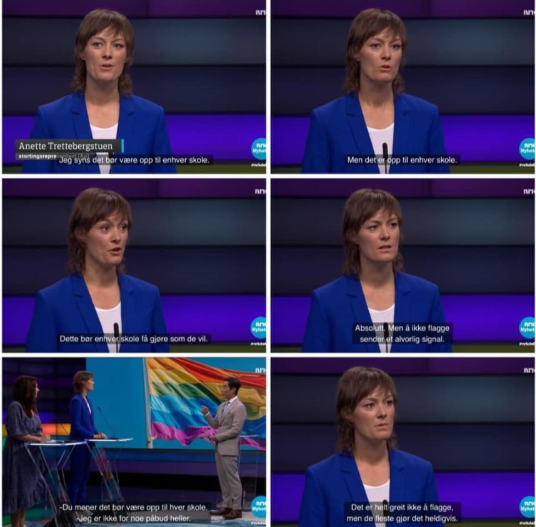
Annette Trettebergstuen (Labour Party), former Minister of Culture and Equality, expresses that it should be up to each school whether they want to celebrate pride, while at the same time she believes that not flying the flag with pride sendsout a serious signal, and that most people fortunately do. She also expresses that parents who do not support pride show that they are bothknowledge-less and prejudiced.
Screenshot from The Debate on NRK TV
According to the Equality and Discrimination Ombudsman, Bjørn Erik Thon, pride is one of the most important diversity celebrations we have in Norway. He expresses that there is a contradiction between Ålesund's work with diversity and the ban on raising the pride flag in schools. The Ombudsman has now sent a letter to the municipality where they must explain how they work for equality and against discrimination. He does not rule out that there could be similar cases in other municipalities (if others decide to impose similar bans). To NRK, He says he hopes that Ålesund municipality will reconsider and choose to raise the pride flag. The ombudsman has had his wish fulfilled, as the majority of politicians in the Ålesund council have recently decided that the schools will still be allowed to raise the pride flag.
On the government Facebook page we can read a sentimental post by the current Minister of Culture and Equality Lubna Jaffery (Ap), where she expresses that pride has become a symbol that includes everyone – and that there can never be too much pride. She believes that celebrating pride makes you both wiser and kinder, and ends the post with an appeal to those who have not yet realized how beautiful pride is, saying that there will be a new invitation next year.
We also know from previous years that companies have also experienced massivepressure to raise the pride flag. One case that attracted attention last year was Thon Hotel, which first issued a press release stating that they would not raise the flag, but due to massive pressure they were unable to hold out for more than a day. They ended up raising the flag.
What do these examples have in common? Yes, they show a significant pressure for ideological flagging, in some places also in the form of an order, as in Drammen municipality. «But pride is not an ideology!» someone might shout in an immediate emotional reaction. If you think like this, you have understood little of what ideology is. For ideology refers, in short, to a more or less coherent system of ideas about how society should be organized. Ideology can therefore be said to underlie all politics, including pride and its fight for rights.
According to The Great Norwegian Encyclopedia (SNL) the purpose of pride is to highlight queer love and queer identity diversity. Free sex is encouraged, where the only framework seems to be consent and the age of consent. In addition, all forms of desire and sexual fetishes are encouraged, whether this concerns sex between same-sex partners, group sex or sadomasochism (BDSM). After the T was included in the queer movement, people have also been given the freedom to define their own gender completely independent of biological facts. Being who you feel you are is celebrated with the utmost self-assurance.
As shown in the examples above, there is now an expectation that the wider society as whole will join in the celebration of our new state religion; «queer gender and sexuality diversity.» A unified understanding of queer love and queer identity diversity as premises for ethics and morality is also expected, where any heretical behavior must be met with strong condemnation and criticism.
For those familiar with history, pressure or injunctions to adopt an ideological flag are not a new phenomenon. On the contrary, there have been several instances throughout history where the population has been forced to submit to a new mindset in the form of a political symbol.
I'll end this post by letting these examples speak for themselves:
· In the Soviet Union (1922-1991), the flying of the red flag with the hammer and sickle was mandatory on public buildings and during official ceremonies. This symbol represented communism and the supremacy of the working class.
· During Benito Mussolini's fascist regime (1922-1943) in Italy, the use of the fascist symbol, which included the fasces, on flags and other public displays was mandated. This was intended to strengthen the regime's ideological hold on the population.
· During Adolf Hitler's regime (1933-1945) in Germany, the National Socialist swastika flag was made mandatory on all public buildings. This was part of the regime's attempt to create a unified ideological identity and promote the values of National Socialism.
· In the People's Republic of China, especially during the Cultural Revolution (1966-1976) initiated by Mao Zedong, it was common to use red flags and banners with Mao's quotes and images. This was part of the campaign to promote Mao's communist ideology.
· Today, the use of national and ideological symbols is still mandatory in North Korea. The flag of the Democratic People's Republic of Korea, along with images of the Kim family and other communist symbols, is ubiquitous in public spaces.
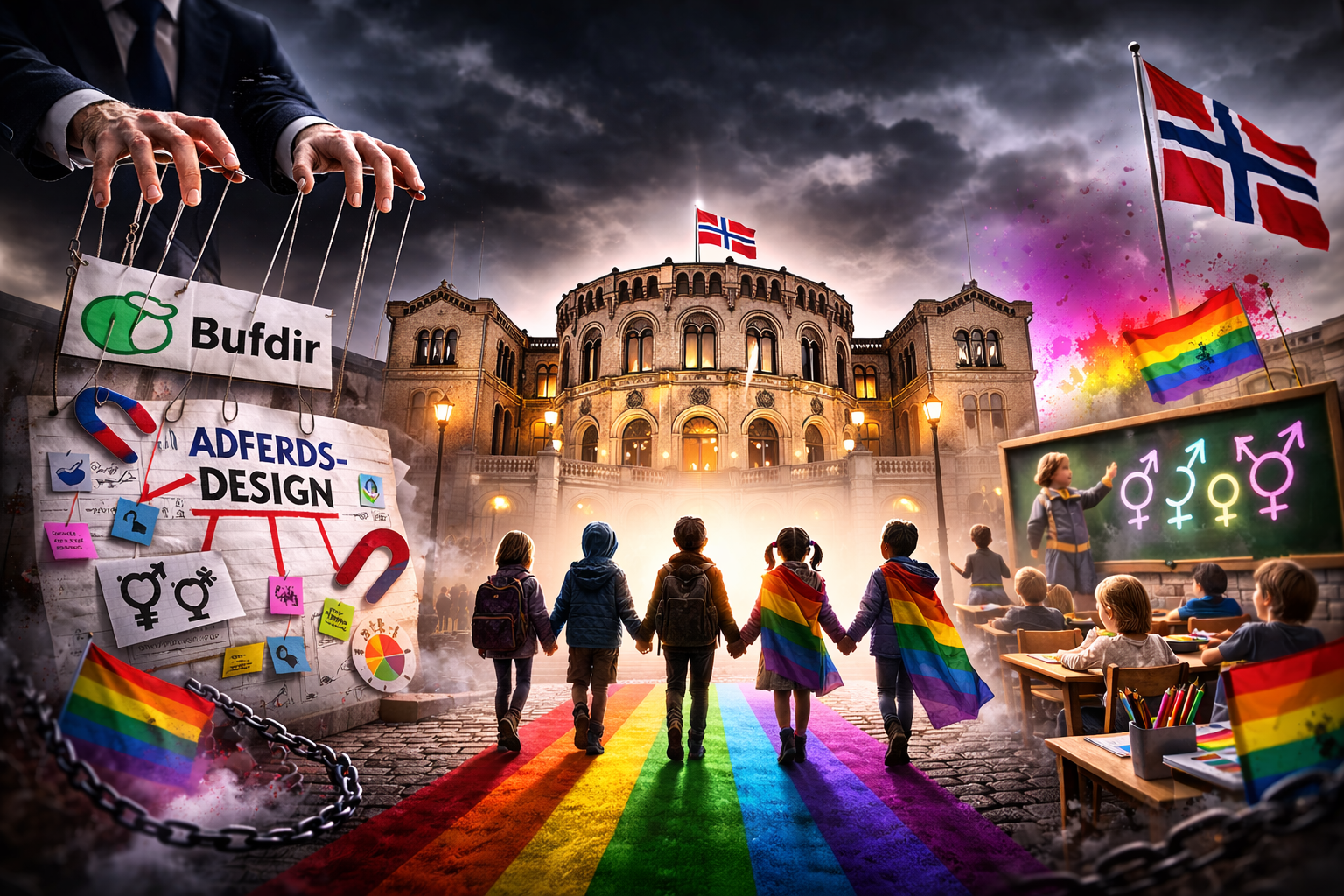
It has recently emerged that Bufdir (the Norwegian Directorate for Children, Youth and Family Affairs) will spend several million kroner on a project in which behavioral design is one of the methods. The goal is to influence public…
Over 1 million people have watched the video where we addressed sexualized activities in kindergartens. Now we follow up with a thorough review of why this is happening – and what food for thought…
There are just over 200 so-called NACS-approved sexologists in Norway who are referred to as experts on gender and sex in the prevailing doctrine that is based on sex-positive philosophy, queer theory and sexually liberal sexology. …
In this podcast episode, Truls Olufsen-Mehus and Tone Lise Gustavsen delve into the complexities of sex education, with a particular focus on new approaches that need to be adopted in the public…
Pornography is often described as a private choice with no consequences for others. In public debate, it is often presented as neutral entertainment, or as an individual need that does not concern the relationship one is in…
Many people today grow up with the understanding that sexual orientation is something fixed and unchangeable – closely linked to one's own self-perception and feelings. This way of thinking characterizes…