Halloween: A harmless celebration or a tradition with dark roots?
Published: 29/10/2024
Halloween has become a tradition that most people associate with dressing up, candy, and scary decorations, and many Christians find it difficult to relate to excluding children from traditions that are now a large part of society.
However, it may be worth asking critical questions about the origins and meaning of this celebration. What is Halloween really about, and where does this tradition come from? Is it just a harmless occasion for fun, or are there deeper, perhaps more problematic, roots behind this holiday?
Occult celebration
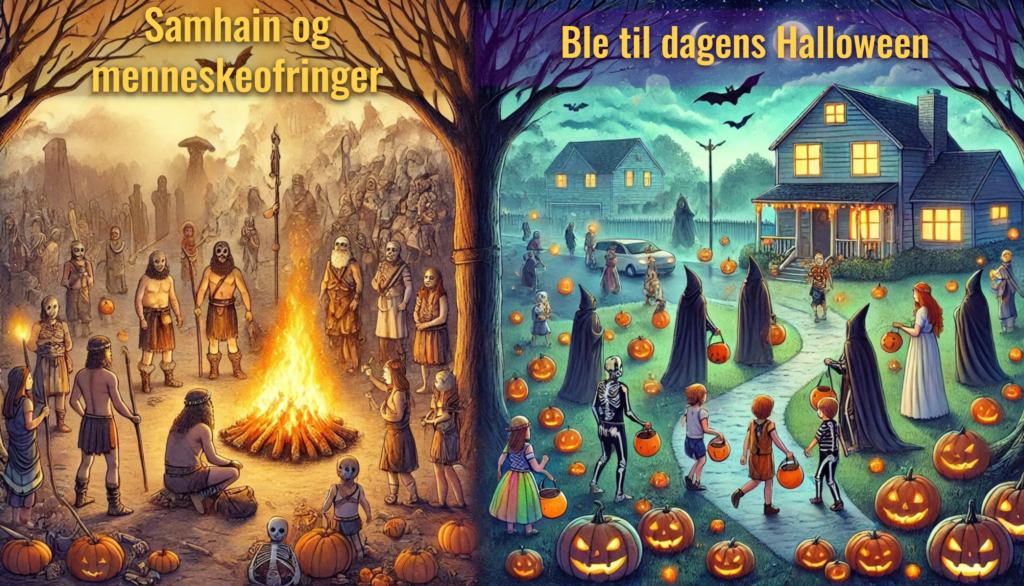
Originally, Halloween was an occult celebration, known as the Celtic festival of Samhain, which began around 2,500 years ago. This festival marked the end of the harvest and the beginning of winter, a transition from light to darkness, and from life to death. The Celtic priests lit large bonfires on hilltops where people gathered to make offerings to the gods. Samhain was seen as a time of divination and spirituality, and it was said that the boundary between the spiritual world and the human world was at its thinnest on this evening.
I Wicca, Also known as the religion of witches, the evening of October 31st is one of their important holidays. This day is considered the witches' New Year, where they invite the dead to come and take part in the rituals and celebrations.
Both The satanic temple , a religious organization that calls itself modern Satanists, and The Satanic Bible by Anton Lavey, point to Halloween as one of the important holidays of Satanists:
“Holiday to celebrate indulgence and embrace the darkness and its aesthetic”
Sacrifices and rituals
Historical sources, including Roman accounts, suggest that the druids performed human sacrifices to appease the gods and ensure the prosperity of the community during Samhain. As priests and scholars, they were responsible for many of the religious rituals, including those involving sacrifices. It is said that the people of Nemed had to give two-thirds of their children, grain, and milk to the monstrous Fomorians, who represented destructive forces of nature. This was seen as a necessary sacrifice to ensure survival through the winter. Samhain is also associated with the god Crom Cruach, to whom it was claimed that firstborn children were sacrificed.
Archaeological evidence supports the theory that both animal and human sacrifices were performed during these festivals.
AI-generated image of Samhain compared to Halloween
When Christianity spread to the Celtic regions, the church began to adapt to local traditions. All Hallows' Eve, now known as Halloween, became a time to remember the dead, and is what we celebrate today as Halloween. This evening was gradually combined with pagan rituals, with Samhain becoming integrated with the Catholic holiday.
By the early 20th century, Halloween was celebrated across the United States, with the American pumpkin replacing the turnip and modern trick-or-treating evolving from “souling” and “guising”
Halloween and Christian values
The celebration of Halloween, whether we realize it or not, continues this dark tradition and idolatry of the ancient Celts. This holiday is important to those who practice the occult, and the celebration promotes values that are in stark contrast to Christian principles.
How can we as Christians approach Halloween in a way that is consistent with our faith? And how can we best deal with a holiday that promotes values that are in stark contrast to our own?
We can choose to create events with a Christian twist, or do something completely different on this day. The most important thing is that we are aware of which tradition we are celebrating. Let us have a good dialogue with our children, gather for prayer and fellowship, and together find good ways to brighten this evening!
It has recently emerged that Bufdir (the Norwegian Directorate for Children, Youth and Family Affairs) will spend several million kroner on a project in which behavioral design is one of the methods. The goal is to influence public…
Over 1 million people have watched the video where we addressed sexualized activities in kindergartens. Now we follow up with a thorough review of why this is happening – and what food for thought…
There are just over 200 so-called NACS-approved sexologists in Norway who are referred to as experts on gender and sex in the prevailing doctrine that is based on sex-positive philosophy, queer theory and sexually liberal sexology. …
In this podcast episode, Truls Olufsen-Mehus and Tone Lise Gustavsen delve into the complexities of sex education, with a particular focus on new approaches that need to be adopted in the public…
Pornography is often described as a private choice with no consequences for others. In public debate, it is often presented as neutral entertainment, or as an individual need that does not concern the relationship one is in…
Many people today grow up with the understanding that sexual orientation is something fixed and unchangeable – closely linked to one's own self-perception and feelings. This way of thinking characterizes…