When US Vice President JD Vance recently stated that the greatest threat to Europe comes not from outside but from within, it sparked an unprecedented fury. Politicians condemned him and the media exploded. How could he say such a thing when Russia is waging a brutal war in Ukraine? When the world is marked by conflict, economic uncertainty and social unrest?
For many, the claim was not only provocative – it was almost unheard of.
But what if we try to understand what lies behind this statement?
If we look at this through a Christian lens, the greatest danger is not necessarily an enemy outside of us. Christianity teaches that humans are created in the image of God, and that life has inviolable value—not because we are strong or useful, but because we exist. And this value applies from conception to natural death. This means that every human life, no matter how small, weak, or vulnerable, has inherent dignity. When a society loses this understanding, it changes how we view ourselves and each other. If we stop believing that life is sacred, it becomes easier to justify choices that would otherwise be unthinkable.
We know that the war in Ukraine has left around 1 million people dead or injured. It is terrible. But since abortion became legal in Europe, 223 million unborn children have lost their lives. In Norway alone, we have removed almost 677,000 children since 1978 – more than the entire population of Oslo.
If we compare this to the wars of the 20th century, where around 108 million people died, we see that abortion alone has cost twice as many lives in Europe as all the world wars combined.
But why don't we react as strongly?
Because abortion doesn't happen with bombs and guns. Because we don't see images of destroyed cities or people fleeing. Because there is no external enemy attacking us. But does that mean these 223 million lives are worth less?
We see Russia as a threat because they take lives. But what if we ourselves, as a society, have accepted a practice that takes many times more lives? A civilization does not always perish because it is attacked from the outside. Sometimes it destroys itself – when it loses respect for life, when it teaches the next generation that some people are wanted, while others are not.
And this does not stop with the unborn. Once we accept that some lives can be chosen, where do we draw the line? In several European countries we see that this is no longer just about unborn children, but also about the sick and elderly. Active euthanasia is becoming increasingly widespread, and more and more people are being offered the opportunity to end their lives – not just because they ask for it, but because society believes that their lives are no longer worth living. When human dignity crumbles, who will be next?
When Vance says that the greatest threat comes from within, he's not talking about downplaying external dangers. He's talking about how societies die when they stop valuing what they're built on. If we stop seeing human life as sacred, what are we really left with?
So perhaps we should ask ourselves: What happens to a society that stops protecting its weakest? What happens to us when we learn to look away?
If we believe that human dignity applies to everyone, we must dare to ask these questions. Are we willing to see what this means in practice?
Marianne Brattgjerd,
Academic Director, Health and Research, Kristent Ressurssenter
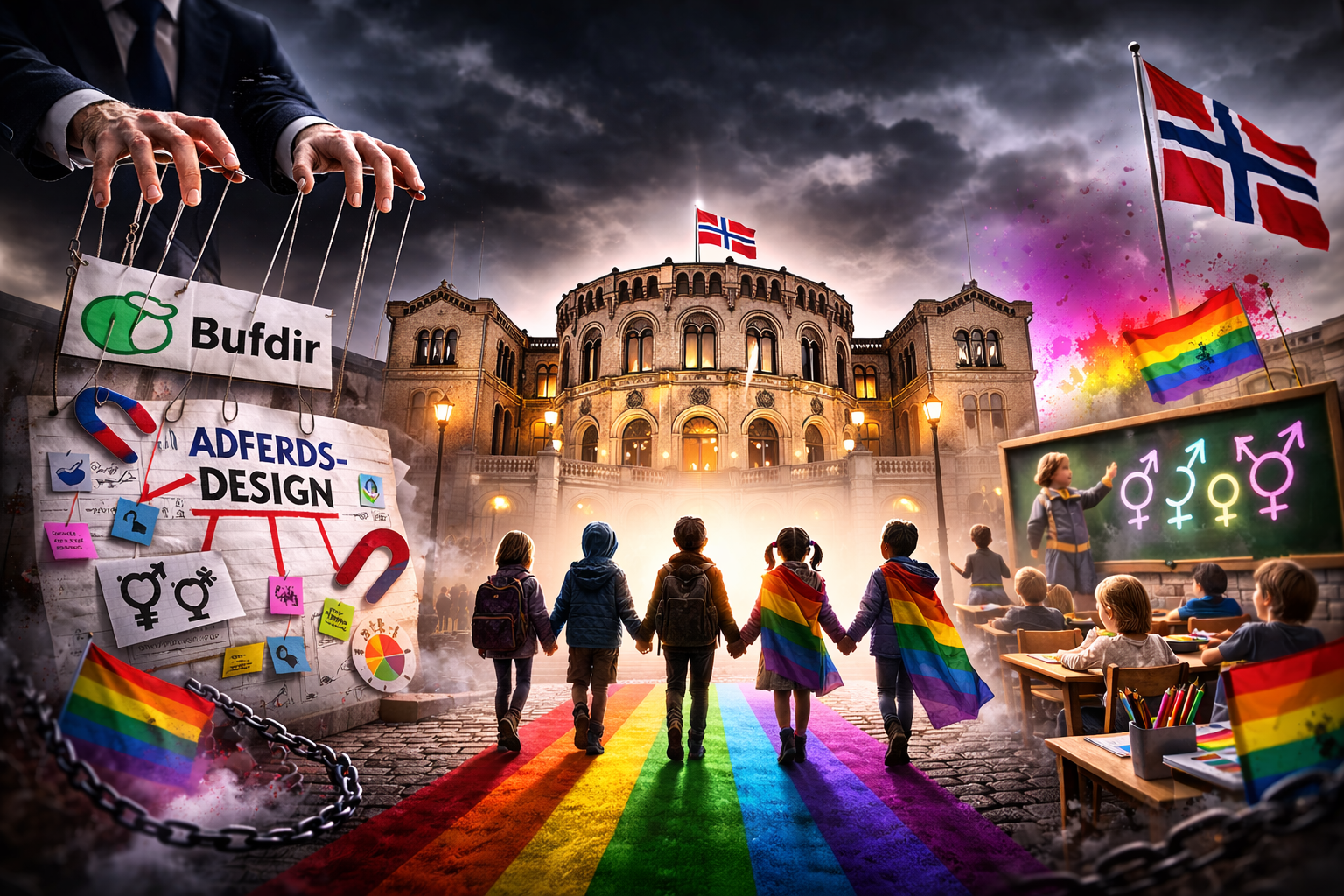
It has recently emerged that Bufdir (the Norwegian Directorate for Children, Youth and Family Affairs) will spend several million kroner on a project in which behavioral design is one of the methods. The goal is to influence public…
Over 1 million people have watched the video where we addressed sexualized activities in kindergartens. Now we follow up with a thorough review of why this is happening – and what food for thought…
There are just over 200 so-called NACS-approved sexologists in Norway who are referred to as experts on gender and sex in the prevailing doctrine that is based on sex-positive philosophy, queer theory and sexually liberal sexology. …
In this podcast episode, Truls Olufsen-Mehus and Tone Lise Gustavsen delve into the complexities of sex education, with a particular focus on new approaches that need to be adopted in the public…
Pornography is often described as a private choice with no consequences for others. In public debate, it is often presented as neutral entertainment, or as an individual need that does not concern the relationship one is in…
Many people today grow up with the understanding that sexual orientation is something fixed and unchangeable – closely linked to one's own self-perception and feelings. This way of thinking characterizes…